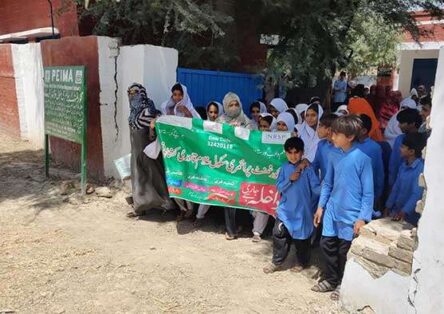
Pakistan has the world’s second-highest number of out-of-school children (OOSC), with approximately 22.8 million children aged 5-16 not attending school, which accounts for 44 percent of the total population in this age range. The number of children not enrolled in schools is highest among the 5-9 age group, with an estimated 5 million children.
As the children progress beyond primary-school age, the number of OOSC doubles, with around 11.4 million adolescents aged 10-14 not receiving formal education. Significant disparities based on gender, socio-economic status, and geography exist, with Sindh having 52 percent of the poorest children (58 percent of whom are girls) out of school, and Balochistan having 78 percent of girls out of school.
The situation further worsened due to the floods of 2022, interrupting the education of more than 3.5 million children, while damaging 25,993 schools in Pakistan, out of which 2859 are in KPK and 2079 in Punjab. These damaged schools are pushing millions of children out of school further adding to the existing out of school children.
Location
Punjab
Khyber Pakhtunkhwa
Sindh
Dera Ghazi Khan
Dera Ismail Khan
Tando Allahyar
Rajanpur
Khyber
Tando Muhammad Khan
Mohmand
Mirpur Khas
Duration:
32 Months (January 2023 – August 2025)
Implementing Partners:
National Rural Support Programme (NRSP)
Sarhad Rural Support Programme (SRSP)
Direct Beneficiaries:
165,3858 students
2,560 teachers
855 School Management Committees
Project Aim
The “Bringing Children Back to School” (Girls and Out of School Children (GOAL) project is supported by the Foreign, Commonwealth, and Development Office (FCDO). The project is built on the Flood Response Plan 2022 consolidated by the United Nations Office for the Coordination of Humanitarian Affairs (OCHA) and in consultations with the FCDO education team.
The project aimed to help mitigate the academic losses of school-going children since the 2022 floods of Pakistan in the target districts. The specific objective of the Project is to ensure that children, especially girls, have access to education and utilise safe, protected, and conducive learning environments in 855 target schools across the target districts.
Key Output Targets
855 partially damaged schools in target areas improved through provision of missing facilities benefitting 165,858 students
Facilitating access to educational supplies for students through provision of 165,858 student learning kits, 66,358 hygiene kits, and 855 school-in-a-box kits
2,560 teachers capacitated to achieve educational milestones and provided with teaching kits
855 School Management Committees (SMCs)/Parent Teacher Committees (PTCs) capacitated in areas of children’s enrolment, provision of psycho-social support to students and better management of improved schools
Key Achievements
855 partially damaged schools in target areas improved through provision of missing facilities benefitting 165,858 students
Facilitated access to educational supplies for students through provision of 165,858 student learning kits, 66,358 hygiene kits, and 855 school-in-a-box kits
530 teachers trained on improving student learning outcomes and provided with teaching kits
855 School Management Committees (SMCs)/Parent Teacher Committees (PTCs) capacitated in areas of children’s enrolment, provision of psycho-social support to students and better management of improved schools